From Maia Mikhaluk in Kyiv (554th day):
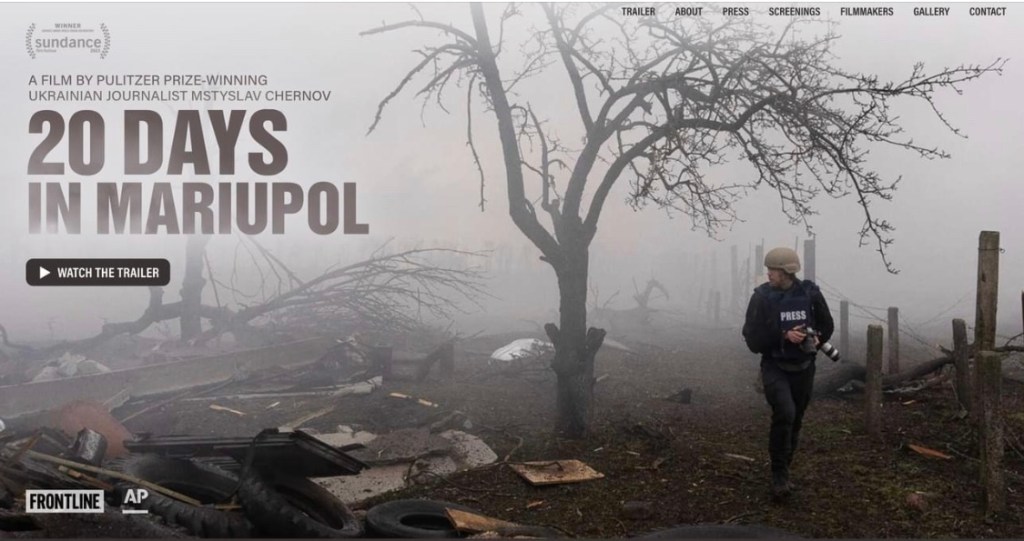
If you can, watch this heart-breaking documentary and allow your heart to break – 20 Days in Mariupol.
“Everyone else was gone: the authorities, the aid workers, the other journalists too. One week into Russia’s full-scale invasion of Ukraine in February 2022, the Associated Press video journalist Mstyslav Chernov was still in the port city of Mariupol, watching from a high floor of a hospital as a tank emblazoned with a white Z pulled up alongside. Smoke kept rising, bitter and black, from the shelled housing blocks a short distance away. There was no way out. Mariupol was surrounded now. Chernov kept his cameras rolling.
“20 Days in Mariupol,” a relentless and truly important documentary, engulfs us in the initial ferocity of Russia’s siege of a city whose name has become a byword for this war’s inhumanity: My Lai, Srebrenica, Aleppo, Mariupol. The A.P. journalists were the last from an international news organization in the city, and for three weeks they documented pregnant women fleeing a bombed maternity hospital, the elderly and the displaced boiling snow to obtain fresh water, the freshly dug ditches where children’s corpses were laid to rest. The reporting would win Chernov, along with his colleagues Evgeniy Maloletka, Vasilisa Stepanenko and Lori Hinnant, this year’s Pulitzer Prize for public service, but because internet connections were sparse to absent in the city, Chernov could only transmit a small fraction of his footage during the siege. It all comes out in “20 Days in Mariupol,” in which the battle to survive in southeast Ukraine becomes entwined with the struggle to tell the world what’s happening.
This film is very hard to watch, and so it should be, though its episodic structure makes it somewhat easier to endure: Day 1 through Day 20, one at a time, from the first bombs to the team’s flight to safety. On the morning of Feb. 24, Chernov and his colleagues head toward Mariupol, a city of half a million people on the Sea of Azov, and drive by Ukrainian military bases whose antiaircraft systems are burning — the first Russian targets, to prepare the path of their war planes. Many residents doubted the violence would reach Mariupol, and evacuation trains were leaving the city half-empty. Now we follow them into improvised shelters: a cold cellar, a CrossFit gym. “I don’t want to die,” says one young boy. “I wish it would all end soon.”…
This text is from an article in The New York Times ‘20 Days in Mariupol’ Review: Last Witnesses in a Martyred City
 Voice of Ukraine