From Maia Mikhaluk in Kyiv (559th day): An article from The Telegraph talks about two trains of thought on what outcome of the war is more beneficial to European security. Long read but gives a good explanation of why pacifying a bully does not lead to peace – just the opposite:
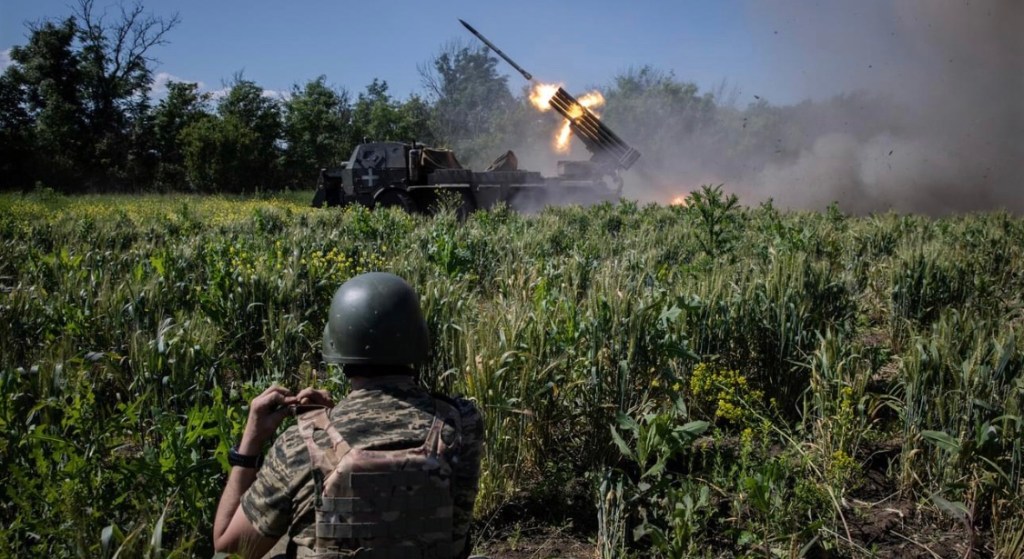
As the summer months begin to give way to autumn, the stoic Ukrainian soldiers are fighting through the heavily defended Russian lines across the south of their country, as multiple breaches across the most heavily defended lines have been widely reported.
These reports are giving increased reason for optimism for eventual Ukrainian success in splitting the Russian land-bridge, and potentially routing the more heavily numbered invaders altogether. This would prove quite the military coup, when only 18 months ago many in the West were writing off the Ukrainians’ ability to repel the invaders and defend their lands.
In the subsequent months attempting to do so, Ukraine has significantly reduced in conventional land combat capability the single biggest threat to European security – the Russian military under a post-imperialist Putin regime, defined by gangsterism and extra-territorial ambition.
There are broadly two different trains of thought amongst western policy makers regarding how one should view the situation vis-à-vis a depleted Russian military and, alongside it, the Putin regime, and the long-term threat posed to European and thus British security.
The first school of thought is an idealistic interpretation of international relations, which sees eventual Russian military and thus strategic defeat in Ukraine as somehow far worse for European security, enraging the Kremlin further to act more desperately.
Accordingly, policy makers and observers who subscribe to this idealistic pacifism, are already calling for peace talks and a peaceful settlement, which inevitably involves Ukraine acceding their own territory to pacify Russian aggression. This misguided school of thought aims to save embarrassing Putin to act more unpredictably.
Putin is far from unpredictable. He is a product of his environment and age; a tyrannical gangster trapped in a Soviet-era mentality of the world, who will time and again seize upon the weaknesses and vulnerabilities of his foes and neighbours alike. An international bully, who like all bullies only respond to strength, not weakness.
In order to react and pre-empt such behaviour, realism supersedes idealistic pacifism. Here we have seen both French and German heads of state played with and disregarded by Putin, as Emmanuel Macron frantically sought to engage with Putin as Russian troops were massing on the Ukrainian border, and even early on in the conflict, whilst Olaf Scholz’s Germany, and Angela Merkel’s before, had been pumping Putin with billions of euros in oil and gas revenues for years.
The ability to look hard facts clear in the eye, take the world as it is not how one would like it to be, and take the political leadership and integrity needed to deal with these events, is what often separates successful strategies from disastrous ones.
Ukraine have done fantastically up to now, and deserve the West’s continued support long after this counter-offensive, likely only two months remaining at most.
Whilst Ukraine continues to erode the Russian military machine, the idealists who preach not to press into Crimea, who call for Putin to not be humiliated, must be disregarded. Time and again, Putin has demonstrably evidenced how his Russia proves the biggest threat to European and British security.
This year’s Integrated Review Refresh correctly articulated Russia as the single biggest threat to UK national security. From the Salisbury poisoning, repeated naval patrols into the Channel, buzzing British skies with fighter jets, threatening our underwater cables, and repeatedly signalling an intent to use nuclear weapons – Putin’s Kremlin is a menace which must be dealt with – as much as the idealistic pacifists may wish to choose business as usual.
This means a long-term commitment to supporting Ukraine both militarily and economically – way past this counter-offensive. In terms of national security, we are witnessing incredibly high levels of return for a relatively modest monetary outlay. Ukraine’s ability to degrade Russia at pace and scale is a once in a lifetime opportunity to ensure peace once again returns to Europe, and we must now press home this advantage over the coming winter months and into next year.
 Voice of Ukraine