From Maia Mikhaluk in Kyiv (624th day):
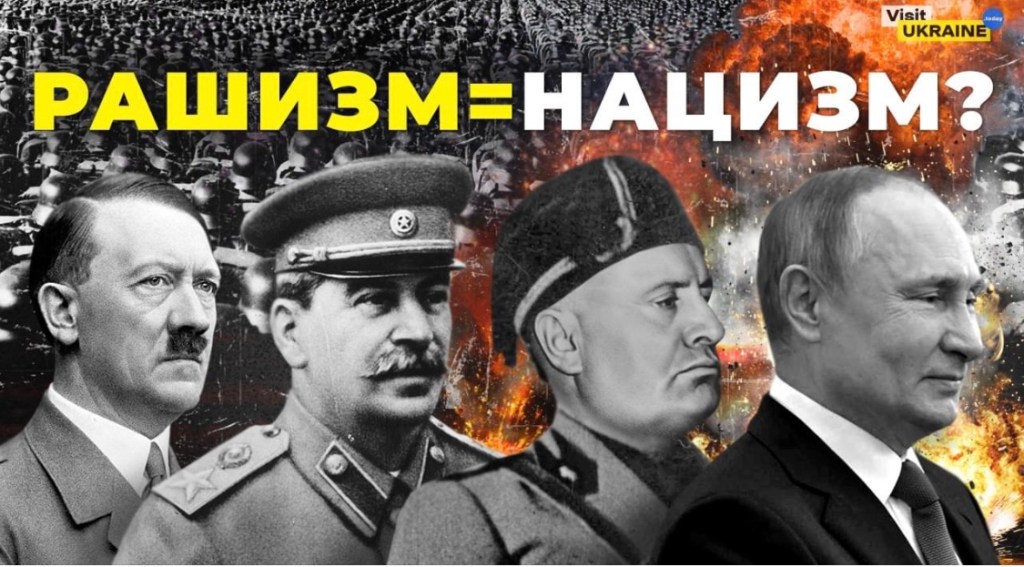
Today is an International Day Against Fascism and Antisemitism in memory of Kristallnacht in 1938, the first mass violent action against Jews coordinated by the Third Reich. On this occasion, NV (Ukrainian media resource) posted an article that reminds how Putin’s ruzzia built an ideology very similar to fascism and how the term “razzism” has already entered world history.
The opinion that Russians are building their world on a special and extremely dangerous ideology was expressed by the president of the Chechen Republic of Ichkeria Dzhokhar Dudayev back in the 90s.
Dudayev insisted that ” razzism” differs from known forms of fascism, racism, and nationalism in its particular cruelty — both to man and to nature. Among other features of “ruzzism ” Dudayev singled out the following:
- scorched earth tactics, the destruction of everything as the main principle of action,
- a schizophrenic form of world domination mania
- slave psychology,
- parasitic on false history, on occupied territories and oppressed peoples,
- constant political, juridical and ideological terrorism.
Russia’s invasion of Crimea and Donbas in 2014 provoked a new wave of discussions about how close the ruzzian regime is to the fascist one . “More and more analysts – experts in Russia – both in the Russian Federation and abroad – began to call the regime of Vladimir Putin “fascist”. Moreover, they do not use this term casually or as a form of condemnation. They mean that Putin’s Russia really resembles Mussolini’s Italy or Hitler’s Germany,” Oleksandr Motil, a professor of political science at Rutgers University and a specialist in the study of Ukraine, Russia and the countries of the former USSR, wrote in April 2015 in his article Is Putin’s Russia Fascist? Even then Motil was leaning towards an affirmative answer.
After listing the arguments of his colleagues, he concluded: “The evidence is convincing. Fascist regimes have charismatic dictators with a hypermasculine cult of personality. These regimes typically exhibit an ethic of hyper-nationalism, a cult of violence, massive youth involvement, high levels of repression, a powerful propaganda machine, and imperialist projects . Fascist regimes are hugely popular—usually because the charismatic leader appeals to broad sections of the population. Putin and his Russia fit this description perfectly.”
In that publication, Motil criticized the Western community for the fact that a large part of it at that time was still afraid to directly compare the Russian regime with fascism. “If Putin’s Russia is fascist, it […] is evil by definition. And this means that calls to understand Putin are equivalent to calls to understand evil. So it’s better to pretend that Russia is not fascist,” Motyl explained this train of thought.
Pseudo-historical, full of distorted facts about Ukraine, Putin’s speech on February 22, 2022, as well as Russia’s full-scale invasion of Ukraine on February 24, finally revealed to the world the essence of modern Russian ideology. Each new day of aggression, each new war crime of the Russian army revealed that it is not only about the views of the Russian authorities but also about what the entire Russian society is.
Ruzzism borrowed quite a few characteristic features of fascism:
- propaganda and rewriting of history
- cult of personality
- genocide of other peoples
- ignoring international law
- one-party system
- close union of the state and the church
- total control over the media
- unlimited influence of the coercive apparatus ( police, special services)
Ruzzism also has some of its own unique features:
- the ideas of the ” special civilizational mission” of the Russians,
- “elder brother to other nations”,
- intolerance to cultural elements of other nations;
- ultranationalism,
- the use of Russian Orthodoxy as a moral doctrine,
- geopolitical instruments of influence, primarily energy provision for European countries,
- military force against countries that are allegedly included in the “sphere of influence of the Russian Federation”.
 Voice of Ukraine