MUNICH—In the whirlwind month since US President Donald Trump reassumed office, no week has featured more intensive activity to negotiate an end to Moscow’s war of aggression against Ukraine than this past one.
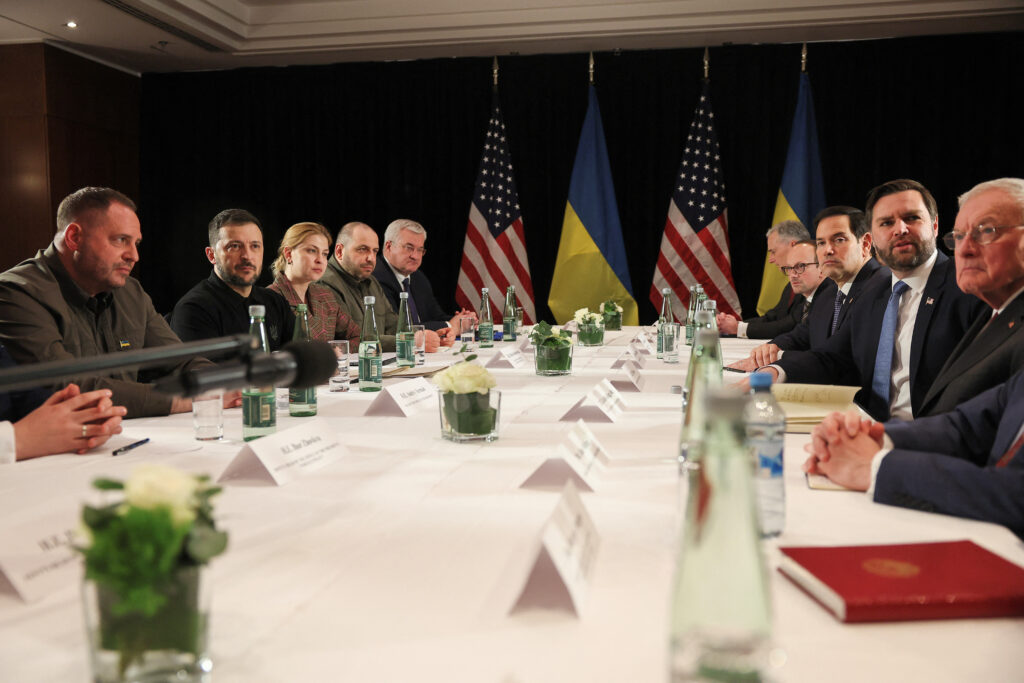
In recent days, US Defense Secretary Pete Hegseth made his first visit to Europe and Trump spoke by phone with Russian President Vladimir Putin and Ukrainian President Volodymyr Zelenskyy. US Vice President JD Vance subsequently met with Zelenskyy at the Munich Security Conference, which also featured appearances by presidential envoys Ric Grenell, Keith Kellogg, and Steve Witkoff. Then came the news of Witkoff, US Secretary of State Marco Rubio, and National Security Advisor Mike Waltz heading to Saudi Arabia this week to start negotiations with the Russians on ending the war.
Controversial statements by Trump in Washington and Hegseth in Europe have prompted many observers to conclude that Trump will move these talks in a direction more sympathetic to the Kremlin’s preferences.
These include Trump’s remarks that:
- he might meet with Putin three times (in Saudi Arabia, Washington, and Moscow), along with his unclear response to a question about whether he considers Zelenskyy a full negotiating partner;
- the prospect of Ukraine joining NATO was the principal reason for the outbreak of the war;
- it is possible that Ukraine might at some point become part of Russia; and
- it might be time for Russia to rejoin the Group of Seven (G7).
Added to this were Hegseth’s statements that it was unrealistic to talk about Ukraine joining NATO or regaining its territory from Russia as part of a peace deal, and ruling out the use of US troops in vouchsafing Ukrainian security.
Another factor was an apparent change in job description for Kellogg, a retired US Army lieutenant general. Months ago, he was announced as the special presidential envoy for Russia and Ukraine. But this past week it became clear that his responsibilities will cover just the Ukrainian and European angles of the peace talks, while Witkoff, the special presidential envoy for the Middle East, will also handle the Russian side of the talks. It may not be a coincidence that Moscow was not enthusiastic about Kellogg’s role in the negotiations.
Taken together, these developments appear to constitute a 180-degree turn from the approach Trump took less than a month ago, when he suggested that Putin was the principal obstacle to peace and threatened sanctions and tariffs to force him to negotiate a durable settlement to the war.
But that is not the end of the story.
In the same press conference where Trump failed to mention Zelenskyy as a full negotiating partner, he said the United States will continue providing aid to Ukraine, because otherwise “Putin would say he won. … And, frankly, we will go as long as we have to go, because we are not gonna let the other happen.”
 Voice of Ukraine