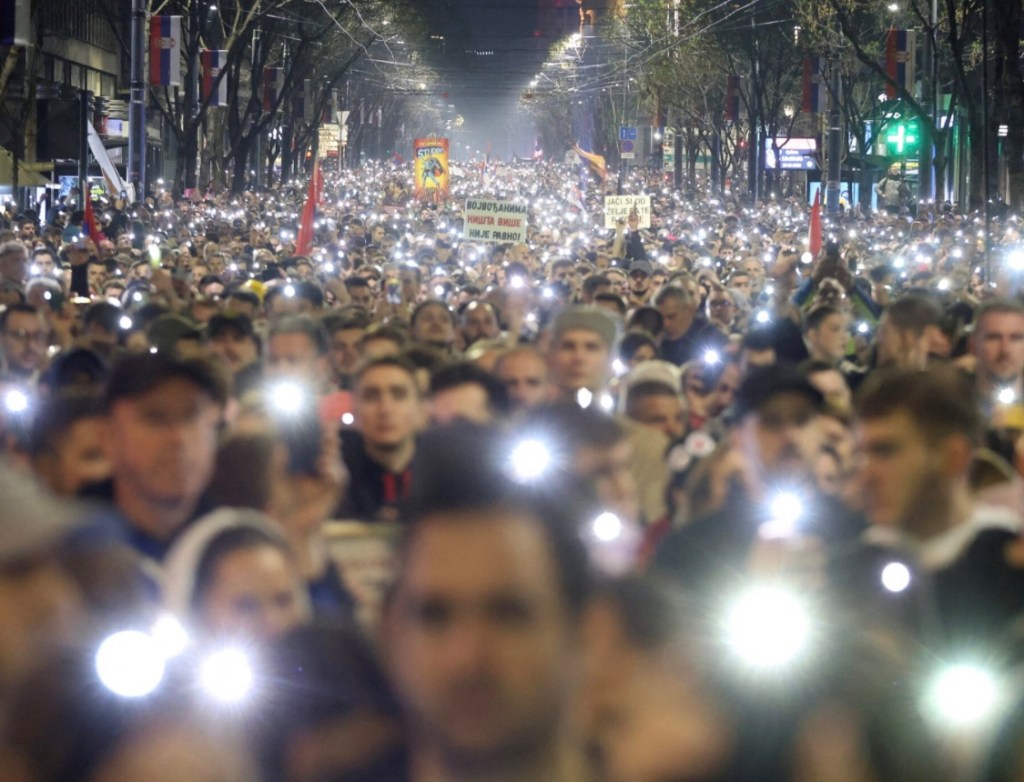
Today, we are bombarded with evidence of rising authoritarianism and retreating liberal democracy, from Russian aggression in Europe to the democratic decline and degradation recently documented by Freedom House and the Economist Intelligence Unit. These twin trends are real and reshaping global affairs. But they do not tell the full story. Consider events that have been unfolding over the past weeks and months in countries in and around Europe, where large and in several cases sustained pro-democracy demonstrations have put some authoritarian regimes on the defensive.
Before zooming in on these storylines, it’s useful to zoom out on the broader sweep of history: For two centuries, Europe has advanced toward liberal democracy in uneven cycles: in 1848, a wave of mostly unsuccessful liberal and patriotic revolts; in 1918, the establishment of mostly liberal-democratic successors to the fallen Russian and Austro-Hungarian empires in Central and Eastern Europe; in the 1920s and 1930s, a surge of authoritarian and fascist takeovers; after 1945, democratic restoration in Western Europe under Pax Americana and Soviet imposition of communism in Central and Eastern Europe; and in 1989-91, a series of mostly successful liberal and patriotic revolts in Central and Eastern Europe. The twenty-first century has featured the ascent of nationalist, populist, and illiberal politics in Western Europe along with authoritarian and illiberal challenges or regression in Central and Eastern Europe.
 Voice of Ukraine