From: Douglas Landro (Area Director – Ukraine One Collective) in Uzhhorod, Ukraine
In the early hours of August 21–22, Russia launched one of its largest aerial assaults of the war, unleashing 574 drones and 40 missiles across Ukraine. Among the targets was a site few expected to come under direct fire: the U.S.-owned Flex electronics plant in Mukachevo, Zakarpattia Oblast. For me, this strike hit especially close to home—literally. The factory is just 20 miles (32.5 km) from my house, a stark reminder of how far-reaching this war has become, even in western Ukraine.
The Attack on the Flex Facility
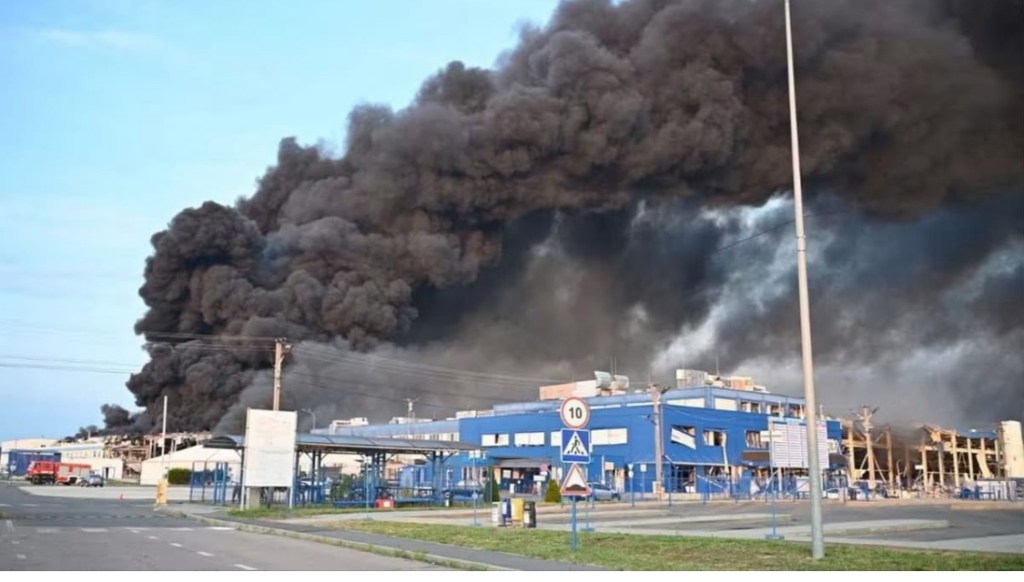
The Flex plant in Mukachevo was struck by two Russian Kalibr cruise missiles, leaving the building badly damaged. The factory, which produces consumer electronics like coffee machines and other household appliances, has no military function.
Inside, about 600 Ukrainian employees were present when the alarms sounded. Quick evacuation into on-site shelters prevented mass casualties, but the blast still left 19 Ukrainian workers injured, with at least six requiring hospitalization. For our region, the attack was a shocking reminder that even far from the front lines, we are not beyond the reach of Russia’s missile arsenal.
President Zelensky’s Condemnation
Ukrainian President Volodymyr Zelenskyy immediately condemned the strike, calling it a deliberate attack on American civilian investment. He argued the assault proved Russia’s disinterest in peace and its willingness to target infrastructure symbolic of Ukraine’s Western ties.
“Russia is not striking at military facilities here,” Zelensky declared, “but at American businesses, at ordinary workers, and at the very possibility of peace itself.”
The American Chamber of Commerce Responds
The attack prompted outrage from the American Chamber of Commerce in Ukraine, whose president, Andy Hunder, described the strike as a direct humiliation of U.S. business. He urged Washington to take a stronger stance, arguing that attacks on American-owned enterprises undermine U.S. credibility and endanger foreign investment in Ukraine’s economy.
The Trump Administration’s Silence
Despite the strike being a direct hit on an American-owned facility and injuring dozens of Ukrainian employees, the Trump administration has remained silent on the incident. No new sanctions have been announced, no retaliatory measures taken, and no public statement made condemning the attack. For many Ukrainians and international observers, this silence has been deeply unsettling, especially as businesses question whether their investments will be protected.
Hungary’s Cautious Reaction
Hungary, Ukraine’s western neighbor with a sizeable ethnic Hungarian population in Zakarpattia, offered a measured response. Prime Minister Viktor Orbán acknowledged the aftermath of the missile strike but stopped short of blaming Russia, instead emphasizing the need for continued peace efforts. Hospitals in Debrecen and Nyíregyháza were reportedly placed on standby in case Ukrainian casualties required transfer, though this proved unnecessary.
Meanwhile, President Tamás Sulyok drew criticism at home after initially posting condolences that mentioned Russia as the aggressor—only to later remove the reference. Foreign Minister Péter Szijjártó also spoke publicly but avoided any direct condemnation, urging instead for dialogue and restraint.
Why This Strike Matters
The Mukachevo strike underscores three critical points:
Geography no longer guarantees safety. Even Zakarpattia, far from the front lines, is now within reach of Russian missile barrages.
Foreign investment is at risk. By hitting an American-owned facility, Russia sent a chilling signal to international companies operating in Ukraine.
Peace talks face new obstacles. Coming amid U.S.-led diplomatic efforts, the attack highlighted the Kremlin’s unwillingness to negotiate in good faith.
Conclusion
The missile strike on Mukachevo’s Flex plant was not just an attack on a civilian factory. It was a symbolic blow aimed at undermining Ukraine’s Western partnerships and discouraging international investment. As Zelensky condemned the attack and the American Chamber of Commerce demanded action, Hungary struck a cautious, conciliatory note.
Meanwhile, the Trump administration has remained silent, leaving the impression that even when American businesses are attacked, Washington’s commitment to defending its economic footprint in Ukraine is uncertain.
For me, the reality is sobering. What once felt distant has come frighteningly close—a U.S.-owned factory just 20 miles from my home, and in a city where many American missionary friends serve – where dozens of Ukrainian workers were injured by Russian missiles. It’s a stark reminder of why Ukraine’s need for protection, investment, and solidarity remains urgent.
 Voice of Ukraine