From: Transform Ukraine By Douglas Landro / September 25, 2025
When Trump’s meeting with Zelensky transformed American policy, Moscow responded with nuclear threats, and Ukrainian drones reached deep into Russian territory while a tortured journalist’s death exposed the war’s true cost
The Story of a Single Day
On the 1309th day of war, the conflict’s trajectory shifted in ways that would have seemed impossible just hours earlier. In a Manhattan conference room at the United Nations, President Trump emerged from his private meeting with Volodymyr Zelensky to declare that Ukraine could “fight and win all of Ukraine back”—words that shattered months of diplomatic assumptions about territorial concessions and frozen conflicts. Within hours, Moscow deployed its most dangerous weapon: nuclear blackmail, with Dmitry Medvedev warning that America must abandon sanctions or face “high risk of direct conflict.”
As diplomats scrambled to process these seismic shifts, Ukrainian drones were already demonstrating a different kind of power projection, striking the massive Gazprom Neftekhim Salavat petrochemical plant 1,300 kilometers inside Russia while naval drones exploded in the Black Sea port of Novorossiysk. Meanwhile, Spanish Defense Minister Margarita Robles discovered that even European skies were no longer safe from Russian interference, as her aircraft lost GPS navigation near Kaliningrad. And in the war’s darkest revelation, investigators finally exposed the horrific details of journalist Viktoriia Roshchyna’s torture and death in Russian captivity—a story that illuminated the true cost of bearing witness to this conflict.
This was more than another day of war; it was the moment when nuclear diplomacy collided with precision technology, when presidential patience met its limits, and when the world witnessed how far this conflict had evolved beyond anything resembling traditional warfare.
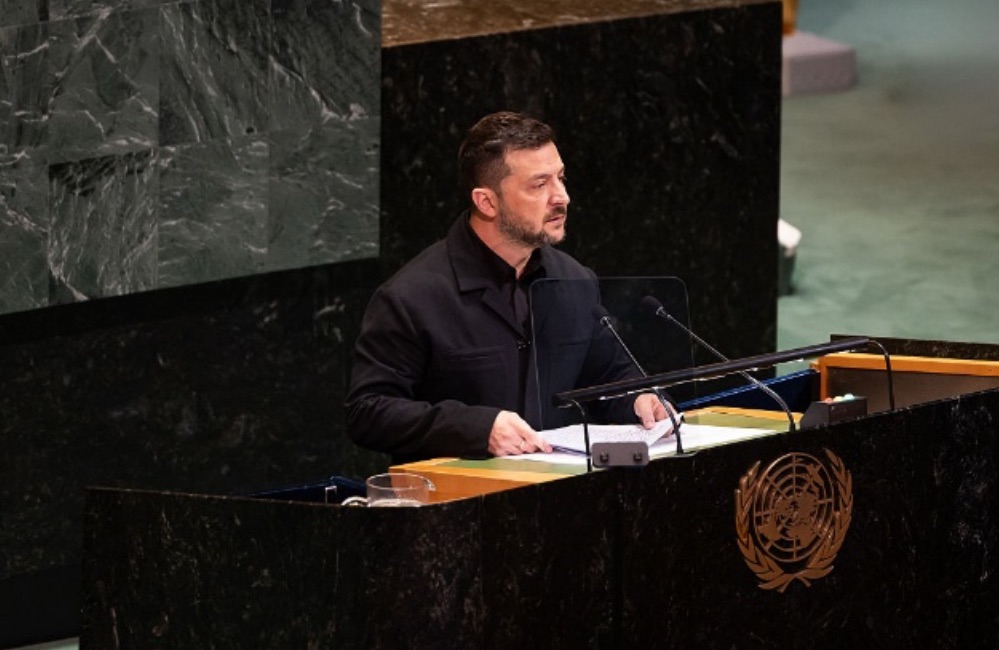
The Manhattan Moment: When Everything Changed
The private meeting between Donald Trump and Volodymyr Zelensky at the UN General Assembly lasted less than an hour, but its aftermath reverberated across continents. When Trump emerged to declare that Ukraine was “in a position to fight and win all of Ukraine back in its original form,” he wasn’t just making a statement—he was abandoning months of carefully constructed diplomatic positions about territorial realities and negotiated settlements.
Zelensky, clearly caught off guard by the transformation, told reporters he was “a little bit surprised by Trump’s shift but welcomed the support.” The Ukrainian president’s surprise was understandable; just a month earlier, Trump had hosted Vladimir Putin in Alaska with promises of facilitating direct negotiations based on current territorial control. Now Trump was suggesting Ukraine could reclaim everything, including Crimea.
“He wants to support Ukraine to the very end,” Zelensky explained, his voice carrying a mixture of relief and amazement. “He understands that Putin doesn’t want this and doesn’t acknowledge that he’s not winning.” The Ukrainian president emphasized that both leaders wanted to “finish this war as quickly as possible,” but now Trump appeared to understand that Putin remained the primary obstacle to any meaningful resolution.
Vice President JD Vance provided the clearest explanation for Trump’s dramatic pivot, telling reporters that the president was “growing incredibly impatient with the Russians right now because he doesn’t feel like they’re putting enough on the table to end the war.” Vance’s words carried the weight of months of frustration, reflecting how Russian intransigence had slowly eroded even Trump’s considerable patience for deal-making.
Secretary of State Marco Rubio reinforced the new American position by announcing that Trump retained “the opportunity and the options” to impose additional sanctions on Russia. Gone was the previous administration’s reluctance to escalate economic pressure; in its place stood a clear warning that America’s “extraordinary patience” had limits, and those limits were rapidly approaching.
 Voice of Ukraine