From: Transform Ukraine By Douglas Landro / September 29, 2025
Russia unleashed its third-largest aerial assault of the war while diplomatic tensions escalated across Europe and Moldova faced its moment of truth at the ballot box
The Story of a Single Day
On September 28, 2025—the 1,314th day of the war—Ukraine reached a new threshold of terror. In the pre-dawn darkness, monitoring stations across Ukraine detected something extraordinary unfolding. Five Tu-95 strategic bombers lifted off from Olenya airfield in Russia’s far north at 1:45 a.m. Minutes later, MiG-31K fighters scrambled from other bases. By 3:52 a.m., more Tu-95s were airborne from Engels. The machinery of Russia’s aerial arsenal was mobilizing for something massive.
What followed over the next twelve hours would become the third-largest combined missile and drone assault of the entire war—643 projectiles hurled at a nation already exhausted by years of bombardment. A twelve-year-old girl would die crushed under concrete. A nurse and patient would perish at a cardiology institute. Polish diplomats would discover missile debris piercing their embassy roof. And across Europe, unidentified drones would appear over military installations, prompting questions about security and sovereignty.
This single day captured the war’s evolution into something far beyond its original boundaries—a conflict where aerial weapons crossed international borders with impunity, where elections in small nations became battlegrounds for great powers, and where the line between war and peace had dissolved into a gray zone of constant threat.
Twelve Hours of Thunder: The Assault Unfolds
The Ukrainian Air Force’s morning report on September 28 read like a catalog of Russia’s entire arsenal. Two Kh-47M2 Kinzhal aeroballistic missiles launched from Lipetsk Oblast. Thirty-eight Kh-101 cruise missiles from Saratov Oblast. Two Banderol drone-launched missiles from Kursk. Eight Kalibr cruise missiles from the Black Sea. And then came the swarm—593 Shahed-type, Gerbera-type, and other drones launched from multiple directions across Russia’s western regions.
The scale was staggering. Ukrainian air defenses responded with unprecedented intensity, downing 611 projectiles including 566 drones, both Banderol missiles, 35 Kh-101 cruise missiles, and all eight Kalibrs. But even the most sophisticated defense network cannot achieve perfection. Five missiles and 31 drones found their targets across sixteen Ukrainian locations, while debris from destroyed projectiles rained down on 25 others.
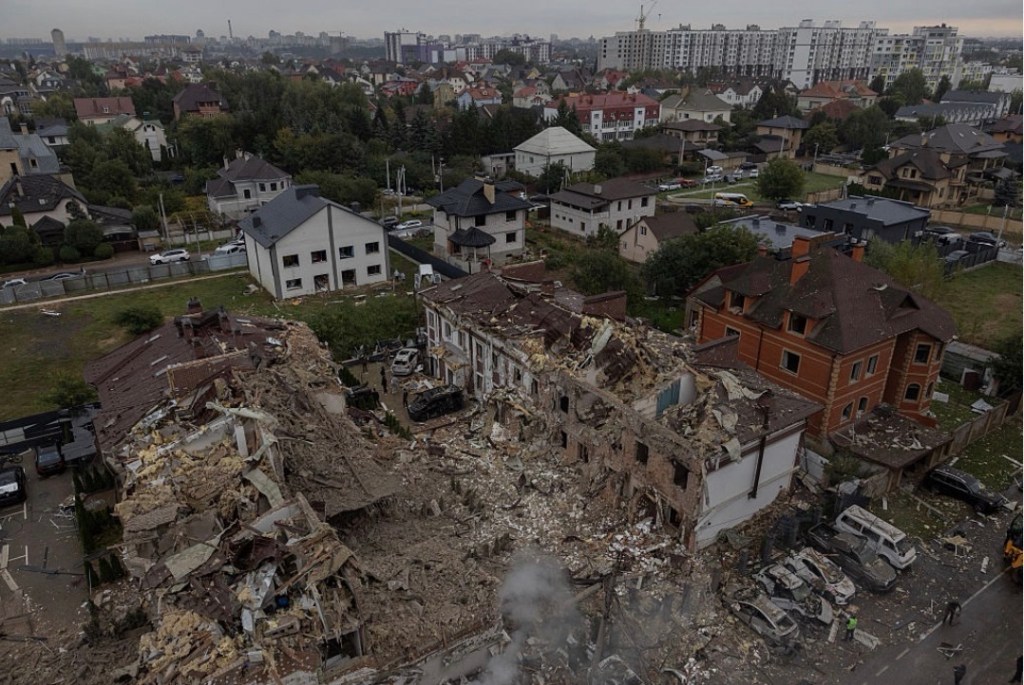
In Kyiv’s Solomianskyi district, residents heard the distinctive shriek of a diving drone at 4:37 a.m., followed immediately by explosion. Moments later, a five-story residential building erupted in flames. Black smoke billowed through the neighborhood as emergency crews raced toward the inferno. When they finally extinguished the blaze and searched through the rubble, they found a twelve-year-old girl crushed beneath a concrete slab—one of four deaths in the capital that morning.
The Cardiology Institute took a direct hit. A nurse and patient died in the attack, their lives ended not on a battlefield but in a place dedicated to healing hearts. Across seven districts of Kyiv, nearly twenty locations suffered damage. Mayor Vitali Klitschko stood amid the destruction, reporting fourteen injured in the capital alone, while another 28 people lay wounded in surrounding Kyiv Oblast, including three children.
The assault demonstrated a grim innovation in Russian tactics. In Konotop, city officials reported that Russian forces had adapted their drone strike methodology—circling Shahed-type drones over residential neighborhoods up to twelve times before striking, deliberately terrorizing residents rather than immediately attacking targets. It was psychological warfare integrated into kinetic operations, turning the drones’ distinctive buzzing engines into instruments of prolonged fear.
 Voice of Ukraine