From: Transform Ukraine By Douglas Landro / October 15, 2025
October 14 brought a new kind of battlefield—where weather grounded drones, armor rolled through mud, and the illusion of steady Western aid finally broke. As Moscow threatened NATO itself, Ukraine fought on under a storm that was more than just rain.
The Day’s Reckoning
It was a day when rain became the battlefield’s silent accomplice. Morning downpours grounded Ukrainian drones just as Russian armor rolled forward through the mud, and by evening, the numbers told a darker truth — Western military aid had fallen nearly in half. Between those two moments, the nature of the war revealed itself with brutal clarity: Russia attacking under cover of weather, Moscow’s officials extending threats beyond Ukraine’s borders into NATO territory, and Europe’s support systems faltering despite their polished acronyms and promises.
This was the war’s 1,329th day — a conflict now shaped as much by the skies as by strategy, where rain could shift the balance of power, and where Russia’s imperial ambitions no longer stopped at alliance borders. It was a day that stripped away illusions: about diplomacy’s reach, about aid’s reliability, and about how close this war has come to swallowing the very security order that once seemed unshakeable.
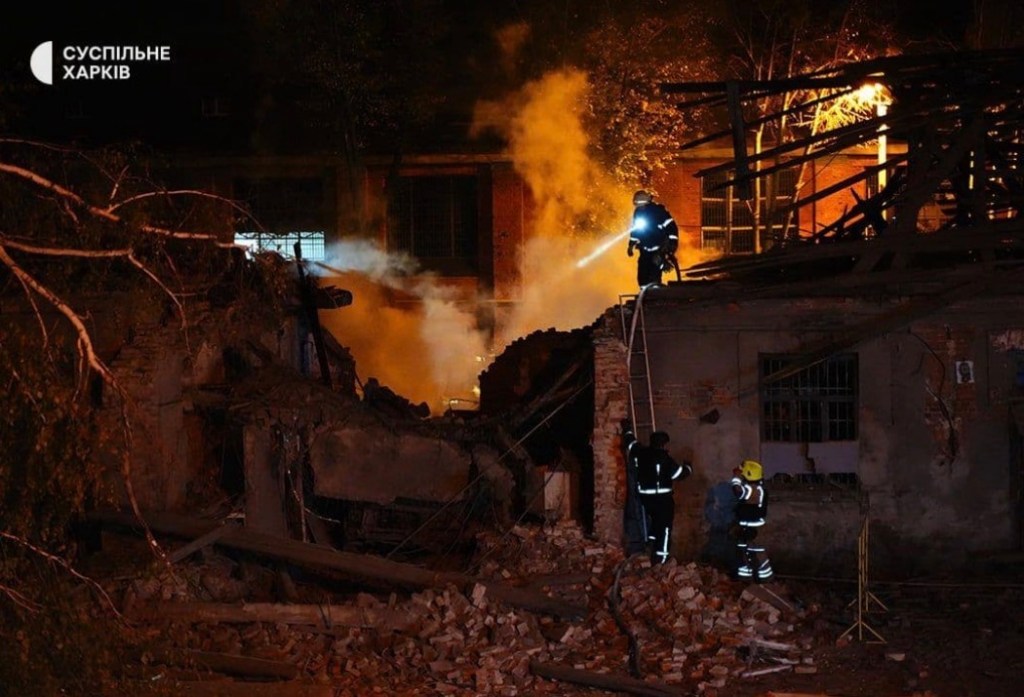
Armor in the Rain: When the Weather Became the Frontline
Morning rain slicked the fields near Dobropillya as Russian armor pushed through the mist — a rare mechanized thrust in a war that had mostly devolved into infantry skirmishes and drone duels. Ukraine’s 1st Azov Army Corps reported that sixteen tanks and armored vehicles, joined by motorcycle-borne infantry, advanced in a coordinated assault aimed at Shakhove. Within hours, Ukrainian defenders destroyed thirteen armored vehicles, three tanks, and three motorcycles — but not before the Russians gained a few dozen meters of mud-soaked ground.
For the first time in months, Russia’s assault looked like something from the war’s earlier years: armored columns rolling forward under the cover of bad weather. Drones — the eyes of Ukraine’s defense — were blinded by the rain. Electronic warfare systems jammed what few managed to fly, and infantry poured from the vehicles to storm Ukrainian trenches.
The participants told their own story. Units from Russia’s 5th Motorized Rifle Brigade and 155th Naval Infantry Brigade — experienced formations, not conscripts — were deployed here, signaling that Moscow had chosen to risk valuable assets for a symbolic push. Weather reports confirmed light rain over the Dobropillya front that morning, exactly the kind of conditions Russian commanders now waited for before launching mechanized operations.
Analyst Kostyantyn Mashovets noted that these same units had struggled for weeks to seize Shakhove. The return to heavy armor suggested a gamble: trade equipment for speed, tanks for territory, metal for momentum. For most of 2025, Russian strategy had favored low-cost infiltration — creeping forward with infantry and accepting slow progress. But this assault showed a new calculation. Moscow was again willing to burn through vehicles if it meant moving the line, even slightly.
In the end, the advance was measured in meters, not miles. Yet it revealed a deeper shift — that in the fourth year of war, even the weather itself had become a weapon.
Weather Warfare: When the Sky Chose Sides
The rain did not just fall—it shifted the balance of the battlefield. Ukrainian commanders in the Pokrovsk sector reported that Russian forces had begun timing their assaults with the weather itself, striking hardest when rain and fog grounded Ukraine’s drones. Losses rose by nearly a fifth, but the pattern held: whenever the skies turned gray, Moscow’s troops moved.
Captain Hryhorii Shapoval of Ukraine’s Eastern Group of Forces said attacks had surged 25–30% in the past ten days, the uptick matching every spell of poor visibility. It was no coincidence. Russian commanders had learned to read the clouds like a tactical map, waiting for fog or wind to silence Ukrainian surveillance before unleashing armor and infantry.
 Voice of Ukraine