From: Transform Ukraine By Douglas Landro / November 30, 2025
As 596 drones and 36 missiles bore down on Ukraine’s capital through the darkest hours, the shelters filled with families clutching pets and blankets—and the morning revealed a city half-darkened, half-defiant.
The Day’s Reckoning
The warnings came before the sirens. By 11 p.m. on November 28, Kyiv residents were descending into shelters, sensing what satellite feeds confirmed: Russia was launching one of its largest combined strikes of the war. Underground parking lots transformed into sanctuaries—children on inflatable mats, cats in carriers, dogs pressed against their owners.
For ten hours, Russian forces hurled 596 Shahed drones and 36 missiles at Ukraine’s capital. Ukrainian air defenses shot down 558 drones and 19 missiles. The 35 that broke through killed three, injured 52, and left half the capital without electricity. Apartment towers burned in six districts.
The assault matched diplomatic theater. As Ukrainian negotiators prepared for Washington peace talks, Russian missiles screamed toward neighborhoods. As Kremlin propagandists flooded social media with AI-generated “mass surrenders,” Russian drones violated Moldovan airspace. While Putin’s envoys whispered about ceasefires, his forces demonstrated Russia’s version of peace: submission under bombardment.
Ukraine answered. While Kyiv burned, Ukrainian drones struck two Russian shadow fleet tankers, turned the Afipsky Oil Refinery into an inferno, and set bomber repair facilities ablaze in Taganrog. The message: Russia strikes civilians, Ukraine strikes the machine.
The Siege of Morning
The first explosion came at 1 a.m., a sharp crack that echoed across the Dnipro. Then another. Within minutes, the night sky turned to fire.
Russian forces had launched 596 Shahed-type drones and 36 ballistic and cruise missiles—a swarm so dense that air defense crews worked in shifts. Ukrainian defenders shot down 558 drones and 19 missiles, filling the darkness with tracer rounds and orange blooms. But 35 drones and missiles broke through, carving destruction across 22 locations.
Victor Mazepa was in his bathroom when the strike came. The blast hurled debris against his building in Solomianskyi district, igniting his car below. His wife and child were in a shelter. “Here is my car. Was,” he said later. “But everyone is alive—that’s the main thing.”
In Sviatoshynskyi district, a drone slammed into a three-story building, sparking a fire that consumed the second floor. Rescuers pulled a man’s body from rubble hours later. In Dniprovskyi and Shevchenkivskyi districts, multiple apartments disintegrated. A child was injured. Seventeen victims were hospitalized. Fifty-two more treated for burns and shrapnel wounds.
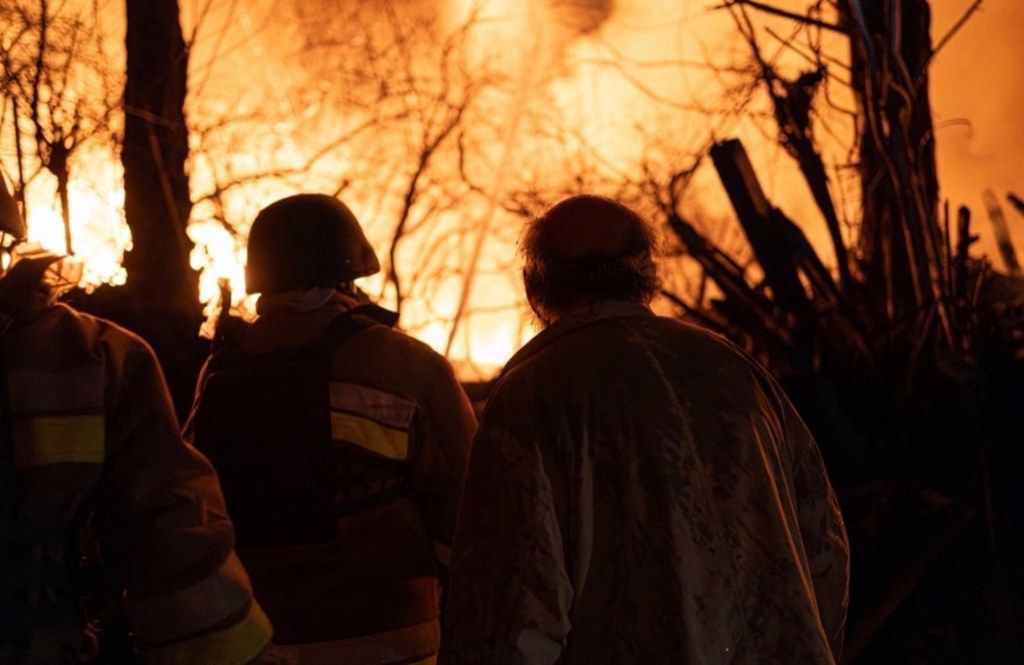
The assault didn’t stop at dawn. At 7 a.m., Russian forces launched a second wave—dozens more missiles, including Kinzhal hypersonics. Power grids failed. The western half of Kyiv went dark. Water pressure dropped. Energy CEO Vitaliy Zaichenko confirmed: “Almost half of Kyiv is without electricity.”
By the all-clear at 8:55 a.m.—nearly ten hours later—fires had consumed six apartment buildings. In Brovary, a drone obliterated two floors, forcing 52 evacuations. In Fastiv, a 55-year-old woman died. In Vyshhorod, another strike killed a man and injured 19, including four children. DTEK restored power to 360,000 households by day’s end, but the scars remained.
Striking the Lifeline: Shadow Fleet Burns
The Black Sea was calm when the drones arrived. Two oil tankers, the Kairos and Virat, were steaming toward Novorossiysk to load Russian crude—empty hulls ready to carry $70 million in oil revenues that would fund more missiles. They never made it.
Ukrainian Sea Baby naval drones closed the distance at high speed. Footage captured the moment: fireballs erupting from hulls, smoke billowing, crew scrambling for lifeboats as the tankers listed and burned. Both vessels suffered critical damage. Both were effectively decommissioned.

The strike was unprecedented. For the first time, Ukraine had attacked Russia’s shadow fleet—the network of aging tankers Moscow uses to evade Western sanctions. The Kairos and Virat were both sanctioned vessels, flagged by the U.S. and EU for transporting Russian crude to India. Destroying them announced that no part of Russia’s war economy was beyond reach.
 Voice of Ukraine