From: Transform Ukraine By Douglas Landro / December 10, 2025
An American president demands Ukrainian elections while calling its leader a con artist comparable to P.T. Barnum, prompting Zelensky to offer a 90-day vote if the West guarantees security—even as his approval rating plummets to 20% and Putin demands Ukraine cede territory Russian forces haven’t captured.
The Day’s Reckoning
The Politico interview aired at precisely the moment Volodymyr Zelensky’s plane touched down in Rome. In Washington, an American president was calling Ukraine’s leader “a great salesman” comparable to P.T. Barnum—a con artist who’d duped “crooked Joe Biden” out of $350 billion. In Italy, that same leader was stepping off the tarmac to meet a pope and a prime minister, carrying an offer that would either salvage Western support or expose its collapse: elections within 90 days, if anyone would guarantee the security to hold them.
December 9, 2025. Day 1,385.
The war had started with tanks. It had evolved into something stranger—a conflict where an American president’s television interview mattered more than any battalion’s advance. Russian forces were still grinding forward, still trading dozens of lives for single square kilometers of rubble. But the real battle was unfolding in diplomatic corridors and TV studios, where politicians calculated not how to win but how long their publics would tolerate paying for someone else’s survival.
Three fault lines converged on this single Monday:
Trump’s patience exhausting, his words signaling that American support now came with conditions—elections, concessions, Zelensky’s resignation if necessary.
Zelensky sprinting across Europe, desperate to secure commitments before Washington’s support evaporated entirely.
Putin’s demands unchanged, insisting Ukraine cede territories Russian forces hadn’t even captured, demonstrating that Moscow would accept nothing less than capitulation regardless of what the battlefield actually showed.
Words spoken in Washington. Responses delivered in Rome. And in Pokrovsk, Russian forces concentrated 155,000 troops to capture a city they were demolishing into rubble.
The war continued. But this day, the battlefield had become secondary.
When the President Chose His Words
The Politico cameras were rolling when Donald Trump decided to say what he’d been thinking for months.
“Zelensky is going to have to get on the ball and start accepting things.” No diplomatic cushioning. No careful phrasing. Just the blunt assessment of a president who’d run out of patience. “Ukraine has lost a lot of land… you certainly wouldn’t say it’s a victory.”
Then came the comparison that would echo through Kyiv’s government quarter: P.T. Barnum. The 19th-century showman. “A great salesman,” Trump said, “who could sell any product at any time.” Translation: Zelensky had conned “crooked Joe Biden” into handing over “$350 billion.”
Trump claimed Ukraine had lost 27,000 soldiers in the past month alone. No evidence provided. He suggested Zelensky should consider stepping down because “Ukraine will lose.” He lingered over maps like a man admiring real estate. “Every time I look at that map, I said, ‘Oh, this Crimea is so beautiful. It’s surrounded on four sides by ocean… It’s got the best weather, best everything.’”
His geography was wrong—Crimea is a peninsula—but his meaning was clear.
When asked which country held the stronger negotiating position, Trump didn’t hesitate. “There can be no question about it. It’s Russia. It’s a much bigger country… They’re much stronger in that sense.” He praised Ukrainian bravery, then delivered the verdict: “At some point size will win.”
Elections? “Yeah, I think so. It’s been a long time. They’re using war not to hold an election… the Ukrainian people should have that choice.” The Ukrainian constitution’s prohibition on elections during martial law? Mere technicality. Zelensky’s continuation in office? Democratic illegitimacy, not constitutional necessity.
Behind the criticism lay Trump’s old conviction: NATO expansion had provoked this war. He repeated the debunked Kremlin narrative about agreements that “long before Putin” promised Ukraine would never join NATO—claims James Baker and Mikhail Gorbachev himself had categorically denied.
In Brussels, Paris, and Berlin, European leaders watched the interview and understood: the president who controlled their alliance’s military backbone was publicly undermining Ukrainian resolve while validating Russian conquest. His words weren’t just criticism.
They were policy.
The Race Against American Patience
Zelensky’s morning began with a briefing about London. Ukrainian negotiators had spent hours with EU national security advisers, revising a peace proposal they’d present to Washington. “The Ukrainian and European components are now more developed,” Zelensky announced, each word carefully chosen. “We are ready to present them to our partners in the U.S.”
The subtext was louder than the statement: Please wait. We’re doing what you asked. Just don’t abandon us yet.
By afternoon, he was in Rome.
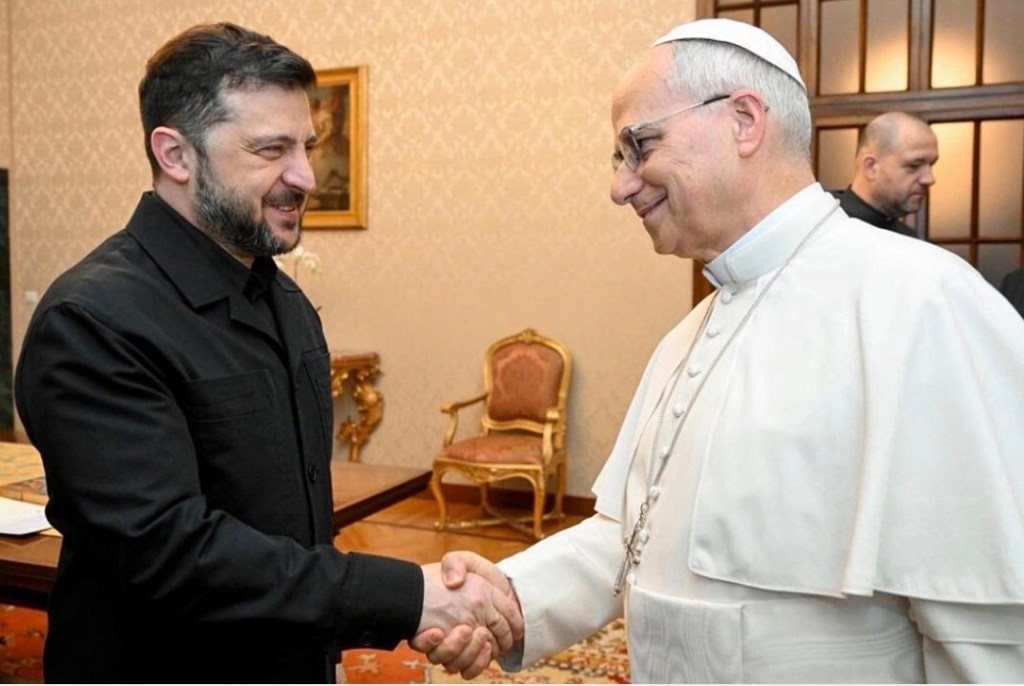
Thirty minutes with Pope Leo XIV at Castel Gandolfo. The Vatican’s careful description: discussions on “the need for the continuation of dialogue” and “prisoners of war and the need to assure the return of Ukrainian children.” Vatican diplomacy—supporting Ukraine’s sovereignty while positioning itself as potential mediator. Zelensky extended an invitation: visit Ukraine. “A strong signal of support for our people.”
 Voice of Ukraine