From: Transform Ukraine By Douglas Landro / September 9, 2025
A Single Day Revealed How Putin’s War Machine Reaches from Arctic Borders to Asian Markets—and Why One Village Matters
September 8, 2025, began with explosions in a Russian military parking lot 6,000 kilometers from Ukraine and ended with a grim accounting of summer’s battlefield mathematics. Between these bookends lay a day that crystallized how thoroughly Vladimir Putin’s war has reshaped the world—stretching from threatened Finnish forests to plummeting Chinese trade figures, from Ukrainian villages changing hands to Russian grocery stores under prosecutor investigation.
This was the day Moscow’s intimidation playbook, perfected against Ukraine, turned toward Finland. It was the day Ukrainian soldiers planted their flag in yet another reclaimed village while Russian military planners quietly shelved invasion plans for southern Ukraine. Most tellingly, it was a day that revealed the true cost of Russia’s summer offensive: over 1,500 square kilometers of Ukrainian territory seized at the price of nearly 95,000 Russian lives.
The Morning That Shook Khabarovsk
At precisely 9 AM in the far-eastern Russian city of Khabarovsk, two explosions shattered the routine of soldiers arriving for duty. The blasts in a military parking lot killed and wounded members of the 748th Separate Operational Battalion—a unit that Ukrainian intelligence had marked for a very specific reason.
These weren’t random Russian soldiers. Three years earlier, this same battalion had participated in the siege of Kyiv, leaving behind the horrors of Bucha and Irpin where hundreds of Ukrainian civilians were tortured, raped, and executed. Now, as morning commuters navigated around hastily blocked roads and mysteriously rerouted buses in Khabarovsk, the ghosts of those Ukrainian suburbs had traveled across an entire continent.
The precision of the timing—exactly when soldiers reported for duty—spoke to months of careful planning. Ukrainian military intelligence had reached across 6,000 kilometers of Russian territory to deliver what they saw as justice. In a war where accountability often seems impossible, someone had made it very personal.
Russian authorities immediately cut mobile internet and altered public transport routes, desperate to prevent locals from learning what they euphemistically called an “extraordinary event.” But the message had already traveled much further than Khabarovsk’s city limits.
When Putin’s Playbook Met the Finnish Forest
That same morning, as cleanup crews swept debris in Khabarovsk, Dmitry Medvedev was putting the finishing touches on one of the most ominous opinion pieces to emerge from the Kremlin in months. Russia’s Security Council Chairman had a message for Finland that read like a carbon copy of threats once directed at Ukraine.
Medvedev’s September 8 essay in TASS accused Finland of Nazi collaboration, persecution of ethnic Russians, and genocide against Slavic populations. He warned that confrontation with Russia “could lead to the collapse of Finnish statehood forever”—language that Ukrainian officials recognized with chilling familiarity.
Every accusation followed the same template Moscow had used to justify its 2022 invasion. Finland was allegedly Russophobic. NATO was turning the country into “a springboard for attack.” The “root causes” of tension—Medvedev’s exact phrase—traced back to historical grievances that demanded resolution.
For Finns, this represented their worst fears made manifest. The country had abandoned seven decades of military neutrality specifically because of Russia’s Ukrainian invasion, joining NATO as insurance against exactly this kind of intimidation. Now Putin’s inner circle was essentially telling them: you were right to be afraid.
The timing was no accident. Finland had just allowed NATO to open a regional command center in Mikkeli, uncomfortably close to the Russian border. Both countries were now fortifying their shared frontier—a thousand-kilometer line that had once symbolized peaceful coexistence but now bristled with military preparations.
What made Medvedev’s threats particularly chilling was their casual nature. He wasn’t announcing policy changes or military deployments. He was simply planting seeds—the same informational groundwork that preceded Ukraine’s invasion. For anyone paying attention, the message was clear: Finland’s NATO membership hadn’t ended Russian ambitions; it had merely changed the timeline.
The Village That Wouldn’t Surrender
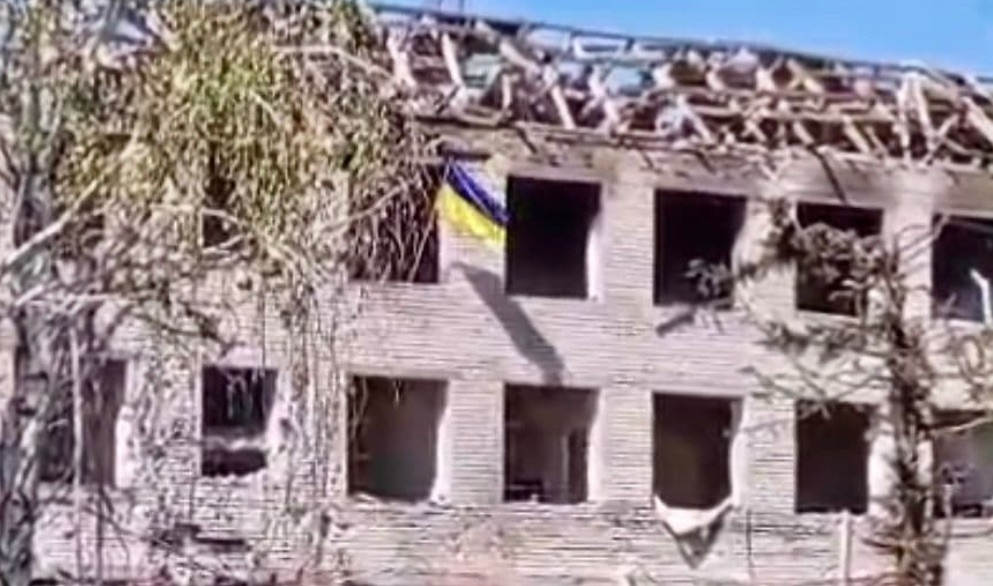
While diplomats parsed the implications of Medvedev’s threats, Ukrainian soldiers of the 425th Skala Assault Regiment were raising their national flag over the village of Zarichne in Donetsk Oblast. To most of the world, the liberation of a single village might seem insignificant. But in the grinding arithmetic of this war, Zarichne represented something precious: proof that Ukraine could still take territory back.
The village sits near key transport routes connecting Sloviansk and Lyman, making its control strategically valuable despite its small size. More importantly, its recapture by the same unit that had earlier cleared Novoekonomichne and Udachne demonstrated that Ukraine’s new Assault Forces weren’t just defensive fighters—they could punch back.
These weren’t isolated victories. Ukrainian intelligence had simultaneously thwarted a much larger Russian operation that would have changed the war’s trajectory. Moscow had been massing forces for a major offensive in the Zaporizhzhia direction, planning to capture the regional capital while coordinating attacks that would encircle Ukrainian forces around Pokrovsk-Myrnohrad.
Commander-in-Chief Oleksandr Syrskyi revealed that Ukrainian countermeasures had forced Russia to abandon the Zaporizhzhia offensive entirely. “The Russians were forced to postpone their offensive in Zaporizhzhia Oblast and redeploy marine units to Donetsk Oblast,” he announced—a rare admission from Moscow that their plans had been completely disrupted.
The failed offensive revealed something crucial about this phase of the war. Russian forces were no longer capable of the sweeping mechanized advances they’d attempted in 2022. Instead, they’d adapted to what military analysts call “infiltration tactics”—small groups of infantry sneaking through Ukrainian lines under cover of vegetation, avoiding direct confrontation while trying to establish footholds deep in enemy territory.
It was working, but at a horrific cost that would become clear only when analysts tallied summer’s casualties.